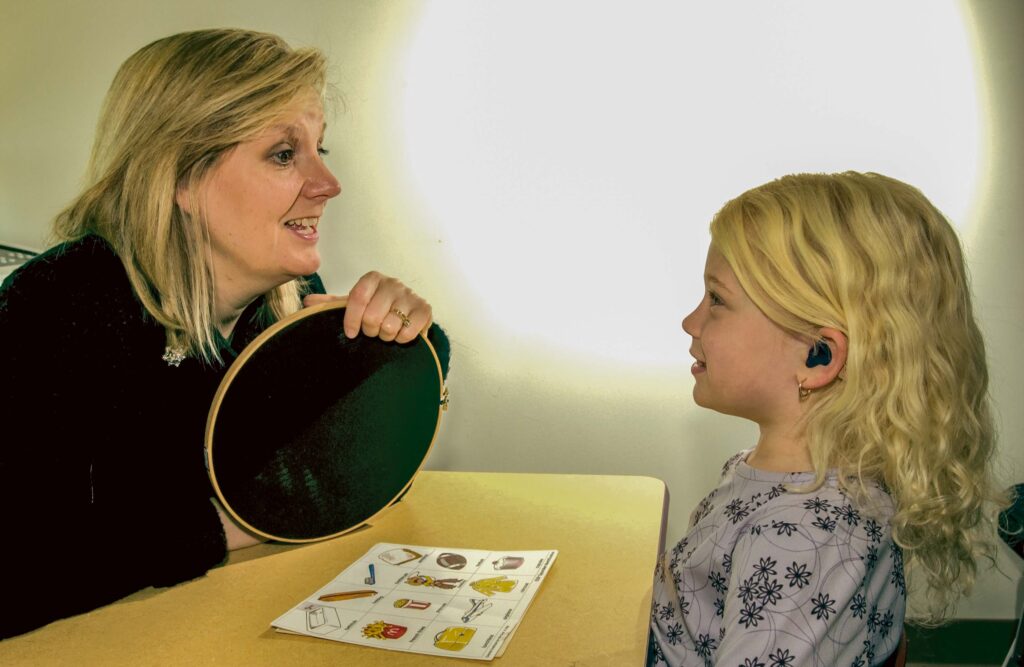
WashU Medicine researcher Lisa Davidson, PhD, and her lab are exploring ways to optimize speech perception in children with hearing loss. Strangely though, the latest technology may not offer the greatest benefit for all types of hearing loss.
According to Davidson, understanding speech requires more than identifying individual vowel and consonant sounds or knowledge of words and sentences. Much of the meaning of speech is conveyed by the so-called prosodic elements of spoken language – intonation, stress and rhythm. Good perception of these elements is known to positively influence spoken language development and reading development of normal hearing children but have largely been ignored in studies of children with hearing loss.
Hearing aids provide an amplification of acoustic hearing and in doing so, retain most of the prosodic elements of spoken language. Cochlear implants provide an electrical form of hearing that provides recipients with appreciation of vowels and consonants but lack the important prosodic elements.
For Davidson, the motivation for extending studies to children with greater levels of residual hearing is due to expanding criteria for cochlear implants. These criteria stress early intervention with bilateral cochlear implants that may eliminate exposure to the prosodic elements of spoken language.
“These recommendations do not address a very logical question,” she said. “Should children with more residual hearing stay with two hearing aids, continue with one hearing aid and receive one cochlear implant, or receive two implants?”
The study has three primary aims:
- Determine the contributions of acoustic experience to the development of suprasegmental and segmental perception in children using two hearing devices;
- Assess the risk-benefit associated with CI- and/or HA-use by establishing audibility ranges for which children with 2 HAs perform better than children with 2 CIs or bimodal devices;
- Quantify the relative contributions of suprasegmental and segmental perception to these same children’s development of spoken language and reading skills.
Davidson hopes these studies will help guide clinicians in making more informed recommendations regarding candidacy for two hearing aids, two CIs or bimodal devices.
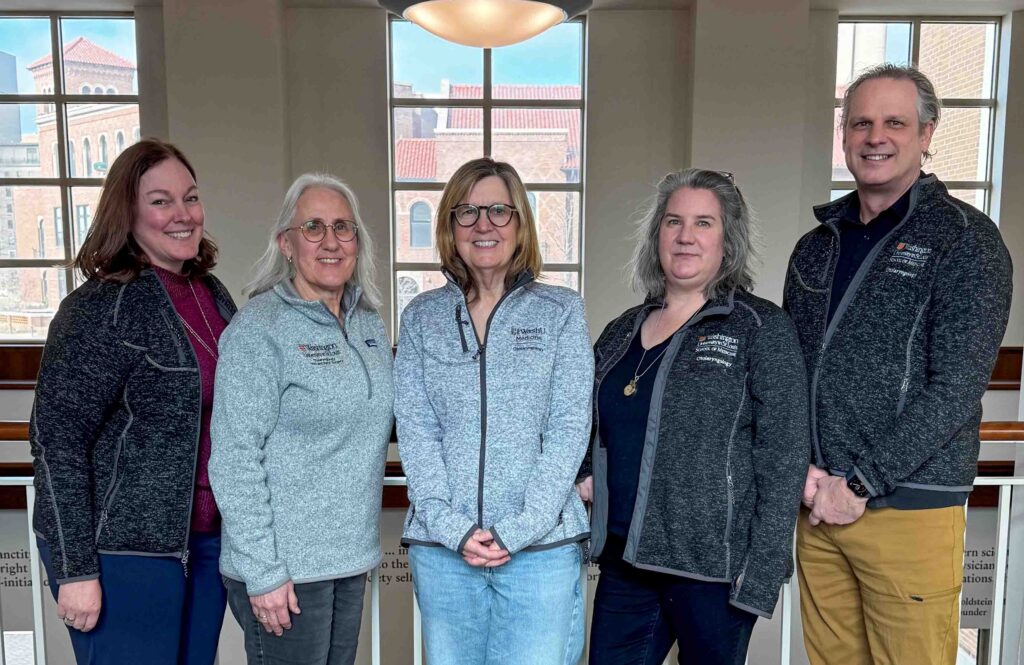
She acknowledges the tremendous support she receives from the 15 different schools for the deaf across the country that allow her access to test their students for her research. Lab members include Elizabeth Mauze, Sarah Pourchot, Marie Richter, Rosalie Uchanski, PhD, and Brent Spehar, PhD.
For more information on these studies, please contact Lisa Davidson at davidsonls@wustl.edu.