
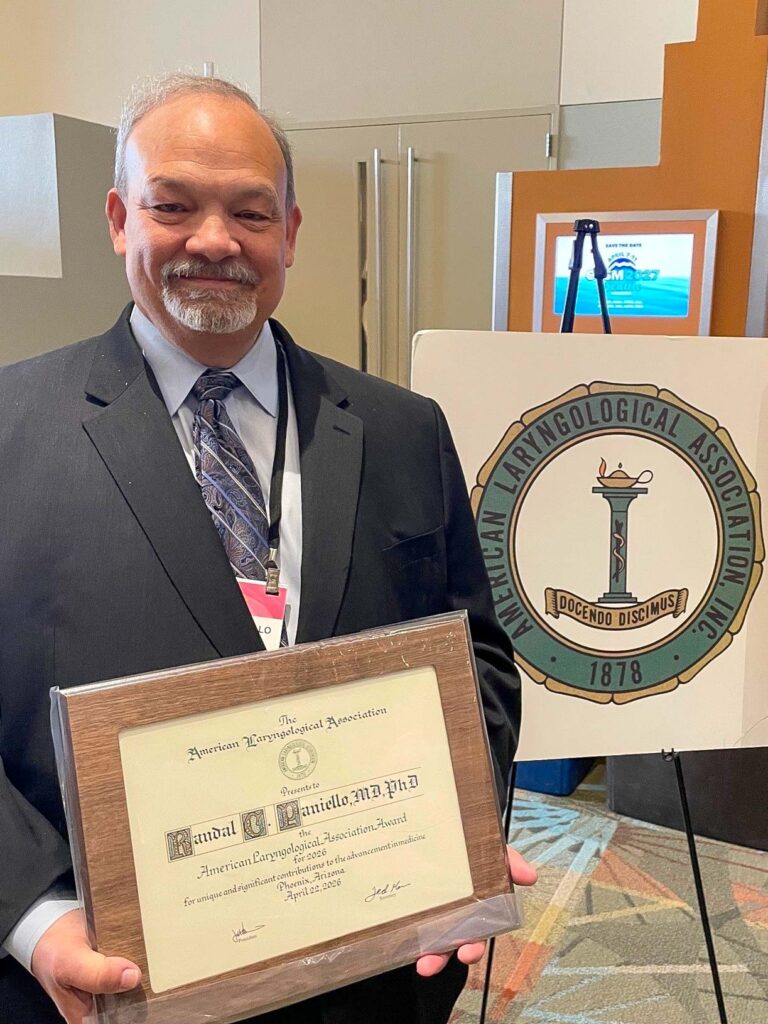
Randal Paniello, MD, PhD, received his medical degree at University of Illinois College of Medicine and completed his residency in otolaryngology at WashU Medicine where he then accepted a faculty position. He subsequently earned an MBA in Health Services Management. His thirst for knowledge seemingly un-quenched, he earned a second undergraduate degree in Mechanical and Aerospace Engineering and a doctoral degree in Earth and Planetary Science. He recently received the American Laryngological Association Award at their annual meeting this month.
What inspired you to enter the field of laryngology?
As a resident in the WashU Medicine program in the 1980s, I found both laryngology and head and neck sub-specialties to be exciting – laryngology for the nuance and the fascinating ways the larynx functions and head and neck for the thrill of the big cases and the satisfaction of sometimes curing someone of a deadly condition. My primary mentors at the time were Gershon Spector and Don Sessions, both of whom were head & neck surgeons who also practiced laryngology. We also had Bob Bastian, an outstanding laryngologist, and Rick Hayden, who taught me to do free flaps, which were new to the head and neck field at that time. When I finished residency I was fortunate to find an academic job in which I could pursue both specialties, and it happened to be right here at WashU Med.
What for you has been most important about a blended career of clinic and research?
As we care for our patients, we constantly encounter questions that have not yet been fully answered or problems for which the ideal solution has not yet been found. As clinician-scientists, rather than just wondering about these questions, we can actually pursue their answers by carrying out research projects. We can also test new surgical ideas in animal models before trying them on patients. I find this back-and-forth between patient care and the lab to be particularly satisfying.
You are noted for some unique surgical achievements like transplanting salivary glands to replace dysfunctional lacrimal (tear) glands. Is there one procedure that is most memorable?
The saying “common things occur commonly” is definitely true, but patients are often referred to academic medical centers for uncommon or unique problems. This gives us a chance to be creative, and to think outside the box, for which I guess I have developed a reputation. Patients with unusual problems call for us to gather all our mental resources and apply our experience to find a solution – a challenge I enjoy. It’s particularly satisfying when it works out!
I guess the most memorable cases are those in which I applied free flap techniques to challenging laryngological problems, blending my two sub-specialty interests. Several such cases come to mind, but Amy Hancock’s story stands out. She lost her larynx to cancer when she was only 21, then failed multiple attempts at TEP voice and hated the electrolarynx. We were able to reconstruct a speaking tract for her using a forearm free flap, and she went on to get married, have kids, and become president of her company. Her story garnered lots of local and national interest, leading to a one-hour special on The Discovery Channel and to her throwing out the first pitch at a Cardinals game.
What does receiving the ALA Award mean to you?
This is a tremendous honor, and it was completely unexpected! I look at the list of past winners and see a real Who’s Who of laryngology. I never thought of myself in that same company. It’s the highest award in laryngology. I’m also quite proud to be the first from WashU to be selected for the award. It means so much to be recognized by your peers for your contributions to the field.
What are you currently working on in the lab, and how soon do you think that might translate into patient care?
My main R01-funded project involves the use of muscle progenitor (“stem”) cells as a treatment for vocal fold paralysis. We found that implantation of these cells into laryngeal muscles results in significant improvement in regeneration of the damaged recurrent laryngeal nerves and in the strength of the muscles. Some of the current research is looking at the basic cellular mechanisms involved in this process, but most of the experiments are repeating the prior experiments (to get a higher N) and testing various parameters that we would want to know for a clinical trial, such as how many cells we should implant, whether to do multiple injections, whether these cells can help people with longstanding paralysis, and so on. We’re hopeful that we can start a clinical trial within 2-3 years.
What advice would you give to residents considering fellowship training in laryngology?
I would say, go for it! Laryngology is a wonderful field that is still growing and there remain many opportunities around the country. It may surprise folks that while some laryngologists are themselves singers, most are not; similarly, most professional voice users that you might take care of are teachers, preachers and lawyers, with only a small number of singers. Some fellowship-trained laryngologists go on to practice comprehensive ENT, so it’s not necessary to abandon all the other sub-specialty skills you learned in residency. And the laryngology lifestyle is good, with very few emergencies.
Anyone else in particular you’d like to credit for a successful career?
I have to thank my wife Jane for her many years of patience and tolerating my late nights and weekends in the lab with my research animals. This is still ongoing! I could not have achieved the ALA Award without her wonderful support.