
Cecilia K. has undergone two surgeries to correct idiopathic subglottic stenosis, but now that she is primary caregiver for a husband diagnosed with early onset Alzheimer’s disease, another surgery is at odds with her lifestyle. WashU Medicine laryngologist Matthew Rohlfing, MD, was able to offer her an alternative, with some rather dramatic results.
Idiopathic subglottic stenosis or iSGS is a rare disease, affecting about 2.5 of every 1,000,000 people in the US. Interestingly, those affected are almost exclusively Caucasian women. Women with this disease experience progressive shortness of breath, often accompanied by a sensation of excess mucus and chronic cough. As the disease progresses, they develop noisy breathing called stridor.
Rohlfing explained the disease is a progressive submucosal fibrosis (scar tissue) in the subglottis, a portion of the airway just below the vocal folds. Progressive thickening of the airway lining causes a circumferential narrowing which constricts the breathing passage.
Subglottic stenosis can be difficult to diagnose
The disease is difficult to diagnose because symptoms are attributed to more common conditions like asthma or allergies.
Cecilia remembers the frustration of misdiagnosis.
“For years I was diagnosed with asthma and underwent numerous asthma treatments, none of which offered much relief,” she said. It wasn’t until I was referred to a lung specialist who ordered a CT scan, that I was properly diagnosed.
Standard treatment is surgical dilation of the airway
According to Rohlfing, typical treatment is operative dilation under general anesthesia. During surgery, a laryngoscope is inserted through the mouth to visualize the narrowed area. Using a combination of cutting (with knife or laser), steroid injections, and balloon dilation, the area is expanded.
“We can typically restore a normal airway diameter with surgery,” he said. “However, the disease slowly returns over time. On average, patients go about two years in between surgical dilation procedures.”
Steroid injection offers a desirable outpatient option
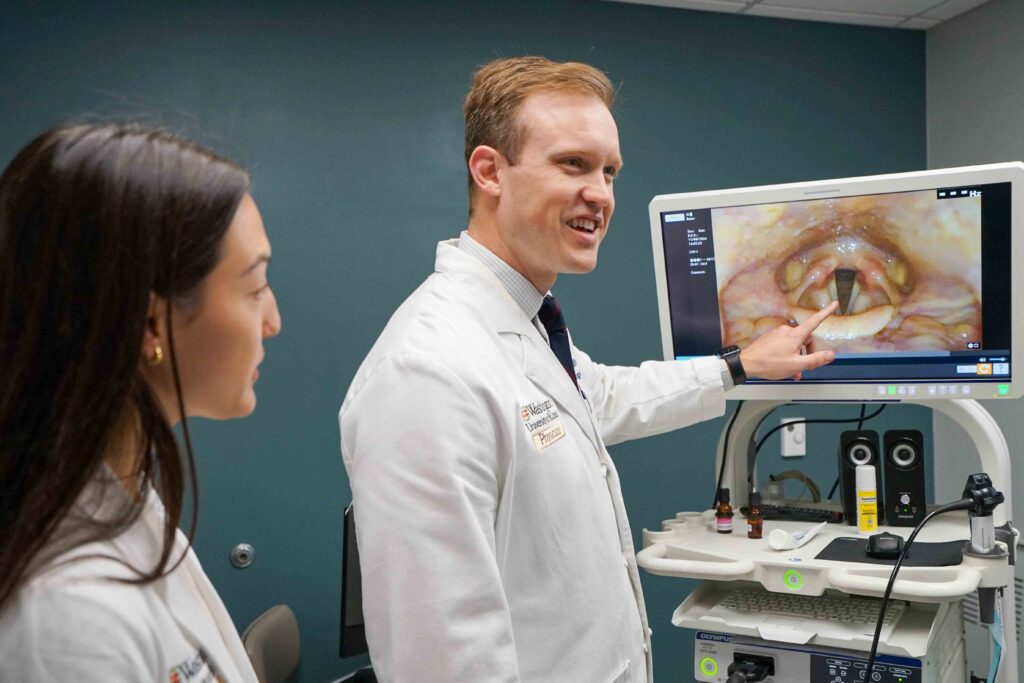
One technique gaining in popularity for treatment of iSGS is called Serial Intralesional Steroid Injections (SILSI). In this procedure, steroids are injected into the diseased lining of the airway while the patient is awake. The patient’s neck, airway and vocal folds are numbed via injection of the skin and anesthetic nose spray. A flexible scope placed through the nose is used to visualize the needle, passed through the neck and into the target tissue.
Rohlfing states Cecilia has shown dramatic improvement with this procedure.
“Cecilia’s airway has improved from 30% of normal to at least 80%, without the need for surgery,” he said. “She has had eight injections over the past three years, and we have been extending the intervals between injections. I am hopeful that she may never need another surgery, and the disease can continue to be managed with these quick, convenient, clinic-based procedures.”
Caring for patients with iSGS is especially rewarding
Cecilia says she sees improvement in her airway within a day of each injection, and the benefit generally lasts several months.
“I totally trust Dr. Rohlfing,” she said. “He’s a great communicator and is very calm and reassuring. I would recommend that anyone with this disease consider this option – it has improved my quality of life immensely!”
“There are few physicians with expertise in this disease process and the various treatment options,” said Rohlfing. “Laryngologists are uniquely equipped to care for these patients, and we have a special interest in doing so at the WashU Medicine Voice and Airway Center.”
For more information about this procedure or idiopathic subglottic stenosis, contact Matthew Rohlfing at rmatthew@wustl.edu.