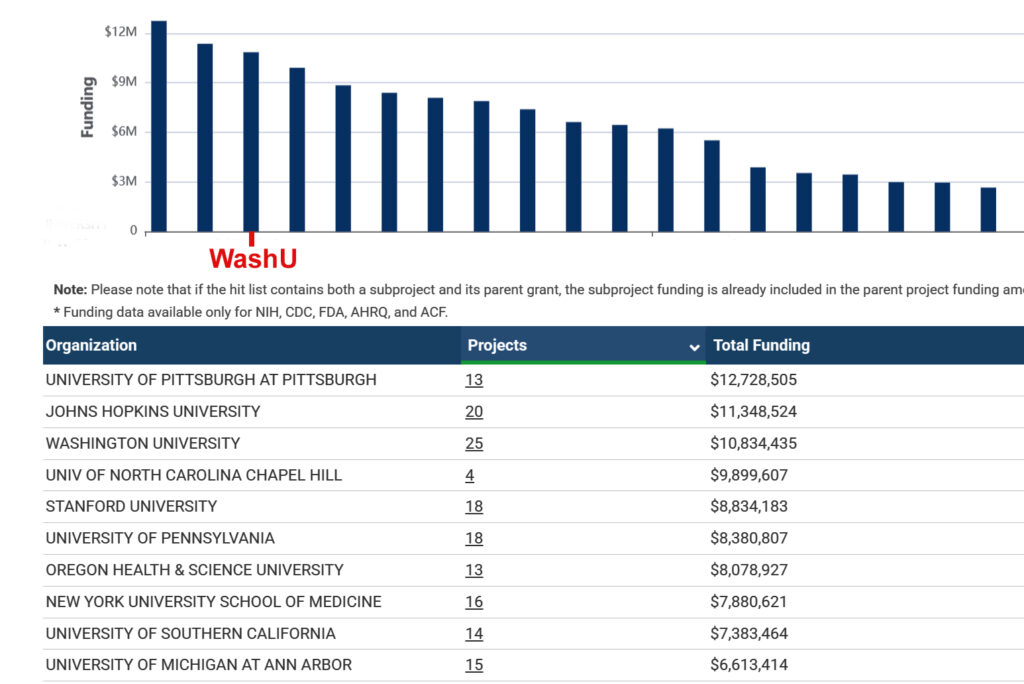
The Department of Otolaryngology – Head and Neck Surgery at WashU Medicine has reached a new summit of research energy. According to current data, the group ranks third in total NIH funding among otolaryngology departments nation-wide, and it ranks first in the number of total projects and R01 awards.
The elevated rank reflects an ongoing improvement in funding acquisition, from a rank of tenth in 2024 to sixth in 2025. According to Lindburg Professor and Chair Sid Puram, MD, PhD, the increase in funding reflects not only the increase in research faculty, but a greater effort by faculty to pursue NIH funding.

“This is a huge achievement,” said Puram, “It reflects our deep and consistent commitment to advancing the care of our patients and the entire field. Our research portfolio continues to diversify, and notably, much of our increase in funding was driven by junior investigators obtaining their first major grants.”
Total funding doesn’t tell the whole story
Total funding is often not the best indicator of research strength for a department or institution because that value doesn’t necessarily reflect the breadth or depth of a research effort in that one or two very large grants creates a misleading value.
According to Puram, the number of major grants may be a better indicator of a successful research program.
“In this domain, we have really excelled with 18 R01/U01 awards, representing the #1 highest number of these major grants in the country,” he said. “This demonstrates a broad and consistent level of support rather than a single project driving all funding, and accordingly, is more foundational and collaborative — without all of these projects coming together we would not have risen so dramatically in funding.”
Building a global force in academic otolaryngology
While revenue is important, it isn’t the only benefit of a successfully funded research program. Top rankings signal academic global dominance and help with retention and recruitment of high-level faculty. It also attracts the best trainees. Finally, it advances our patient care mission by promoting the translation of laboratory discoveries into clinical treatments.