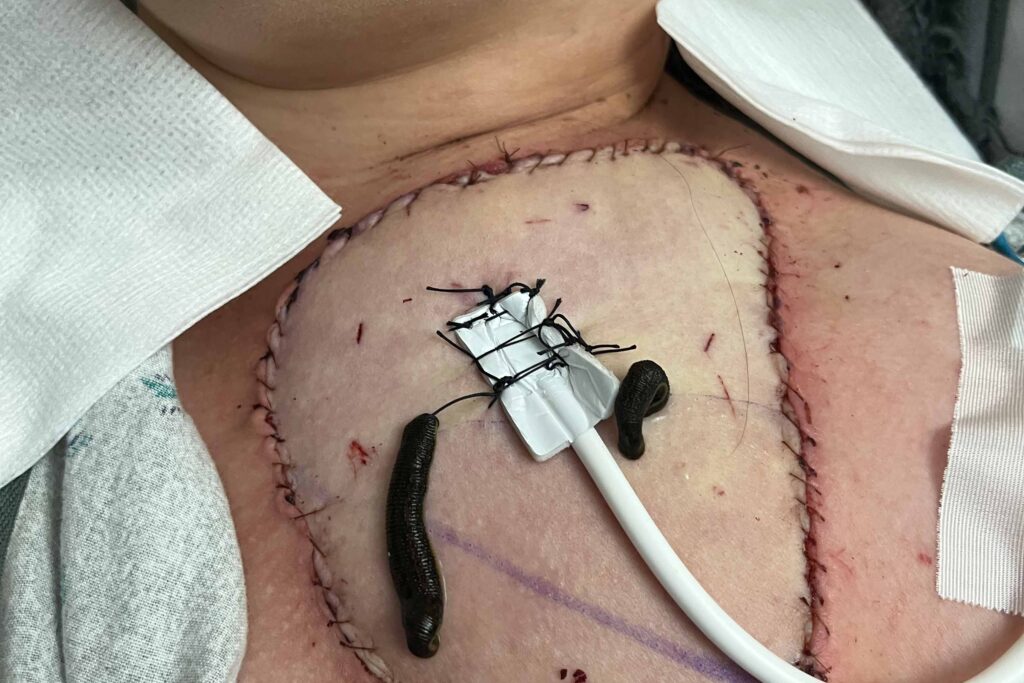
Head and neck surgeons in the Department of Otolaryngology at WashU Medicine are testing a new medicinal therapy to prevent failures due to venous congestion of skin flaps used in reconstructive surgery.
The former tried and true method was leeches – typically 1-3 of the blood suckers placed on the congested flap each hour – for as long as 3-5 days. Medicinal leeches have been used in health care for centuries. Hirudin, a powerful anticoagulant found in leech saliva, was the only way to stop blood clotting prior to the discovery of heparin.

Modern leech usage is mostly limited to plastic and reconstructive surgery, and understandably, patients and family members find the practice distasteful at best. It also comes with a small risk of infection due to the bacteria carried by leeches.
But now, a prescription anticoagulant called enoxaparin (Lovenox) is being tested as the replacement for leech therapy. Lovenox belongs to a group of drugs called low-molecular-weight heparins. It is commonly used to prevent clots after surgeries like hip or knee replacements and to treat deep vein thrombosis. And now, it has been used for the past year to treat the rare venous congestion in reconstructive surgery patients in the Division of Head and Neck Surgery at WashU Medicine.
According to head and neck surgeon Jason Rich, MD, the results are as good as leech therapy and much less gross.
“The treatment is received as a local subcutaneous injection to the flap, given every 2-3 hours,” he said. “It can be administered until adequate venous blood return develops, which may take several days. Overall, it is safer than leech therapy and a more palatable option for patients.”
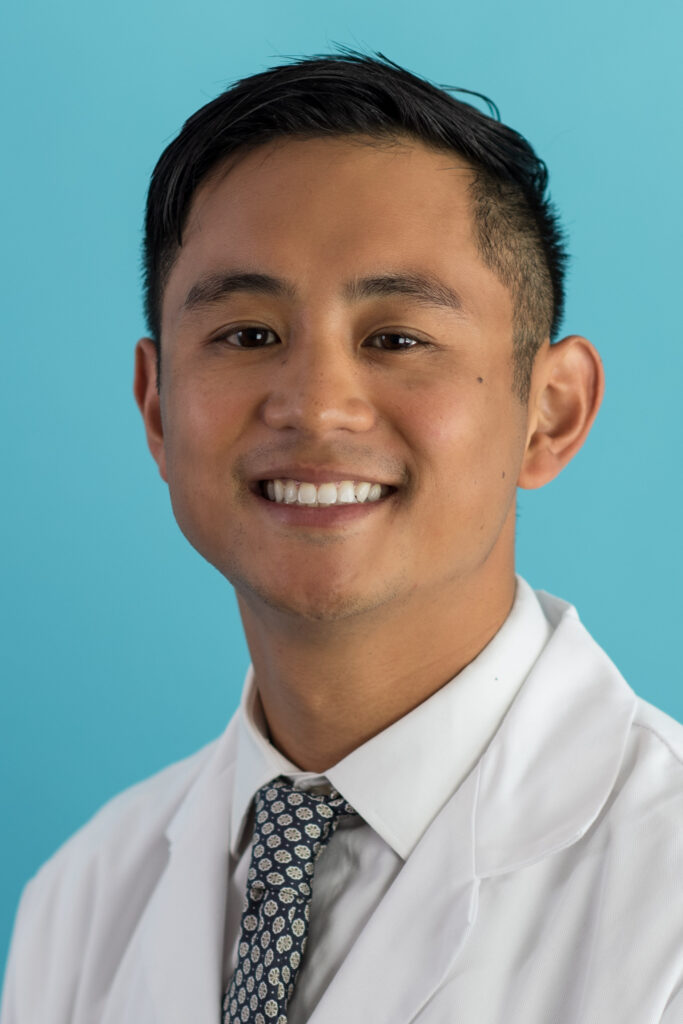
Rich credits Otolaryngology resident Matthew Wu, MD, with development of their treatment protocol.
“Because flap failure is a relatively rare event, it took several months to establish an optimal dosing routine,” said Wu. “Our goals in adopting this protocol were to make enoxaparin the standard approach for head and neck patients here, and to build national awareness of this option.”
To learn more about this new treatment approach, contact Jason Rich, MD, at richj@wustl.edu.